
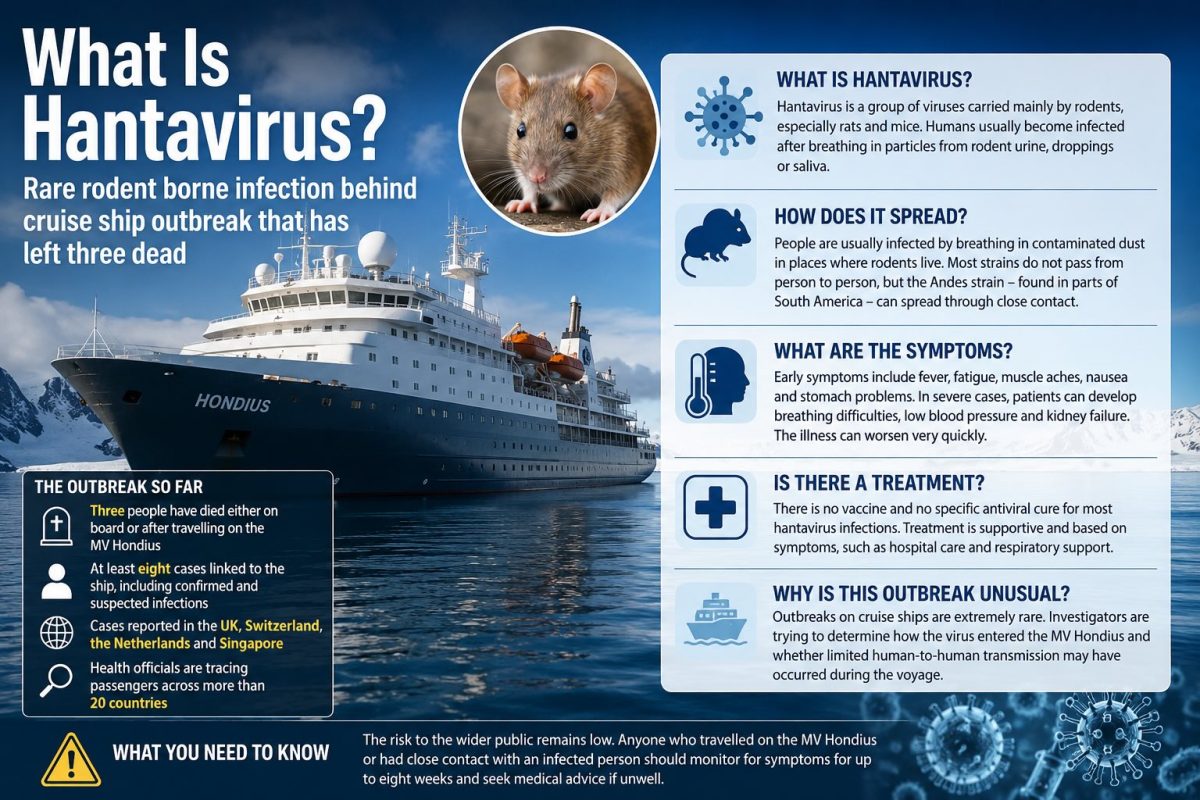
What Is Hantavirus? Rare Rodent Borne Infection Behind Cruise Ship Outbreak That Has Left Three Dead – NATIONAL NEWS
Health officials across several countries are racing to trace passengers from a cruise ship linked to an outbreak of hantavirus, a rare infectious disease that can cause severe lung and kidney failure in humans.
The outbreak has been linked to the MV Hondius, a Dutch operated expedition cruise ship that had been sailing through remote parts of South America and the South Atlantic when passengers began falling ill.
At least three people connected to the voyage have died, while confirmed and suspected infections have now been identified in multiple countries including the UK, Switzerland and the Netherlands.
Two Britons who travelled on the ship are currently self isolating at home in the UK after possible exposure to the virus, according to the UK Health Security Agency.
A 56 year old British passenger, former police officer Martin Anstee, remains in a stable condition after being evacuated from the vessel for hospital treatment in the Netherlands.
Authorities in Singapore, the US and across Europe are now monitoring former passengers who travelled onward on international flights before the outbreak was detected.
The outbreak has attracted global attention because the strain identified aboard the ship appears to be the Andes virus, a form of hantavirus found mainly in parts of Argentina and Chile which, in rare cases, can spread between humans through close contact.
What Is Hantavirus?
Hantavirus is the name for a group of viruses carried mainly by rodents, particularly rats and mice.
Humans usually become infected after breathing in tiny airborne particles contaminated with rodent urine, droppings or saliva.
The disease is rare, but some strains can be extremely dangerous.
Different hantaviruses circulate in different parts of the world. In Europe and Asia, infections more commonly affect the kidneys, while strains found in North and South America can attack the lungs and cause life threatening breathing difficulties.
The virus takes its name from the Hantan River in Korea, where large numbers of soldiers became ill during the Korean War in the 1950s.
Although most people have never heard of hantavirus, experts have long monitored it because severe cases can deteriorate rapidly and carry high fatality rates.
Why This Outbreak Is Unusual
Most hantavirus infections are linked to exposure in rural cabins, farms, campsites or wilderness areas where rodents are present.
Outbreaks aboard cruise ships are exceptionally rare.
Investigators are still trying to determine how the virus entered the MV Hondius. One theory being examined is whether infected passengers may have contracted the illness while travelling through southern Argentina or Chile before boarding the vessel.
Health authorities are particularly concerned because the Andes strain is the only hantavirus known to occasionally spread from person to person.
While such transmission is considered rare, it has previously been documented among close family contacts and caregivers in South America.
That possibility has prompted an international contact tracing effort involving passengers and crew from more than 20 countries.
What Are The Symptoms?
Early symptoms often resemble flu and can include fever, exhaustion, headaches and muscle pain.
Patients may also experience stomach pain, nausea, vomiting and diarrhoea.
In more severe cases, the virus can suddenly worsen, leading to breathing difficulties, dangerously low blood pressure and organ failure.
Doctors say some patients can deteriorate very quickly after initially appearing only mildly ill.
Martin Anstee’s wife Nicola described the past few days as “very dramatic” after her husband’s condition worsened on board the ship.
“The fear with this virus is it can deteriorate very quickly,” she said.
Symptoms can develop anywhere between one and eight weeks after exposure.
Is There A Treatment?
There is currently no widely available vaccine or specific antiviral cure for most hantavirus infections.
Treatment is supportive and focused on managing symptoms, often involving oxygen therapy, intensive hospital care and respiratory support in severe cases.
Experts say early medical attention is crucial because patients who receive treatment quickly have a much better chance of survival.
What Happens Next?
The World Health Organization and health agencies across several countries are continuing to investigate the outbreak.
Officials are trying to determine whether all infections stemmed from a shared exposure before passengers boarded the ship, or whether limited human transmission may have occurred during the voyage itself.
For now, health authorities say the risk to the wider public remains low.
But the outbreak has once again highlighted how quickly infectious diseases can cross borders in an era of global travel, even when involving viruses unfamiliar to much of the public.
For further information visit: https://ukhsa.blog.gov.uk/2026/05/05/what-is-hantavirus-how-is-it-transmitted-and-what-are-the-symptoms/
Comments (0)