
The Ground Beneath Us: What This Summer’s Cracked Soil Really Means for Your Garden, Patio and Home
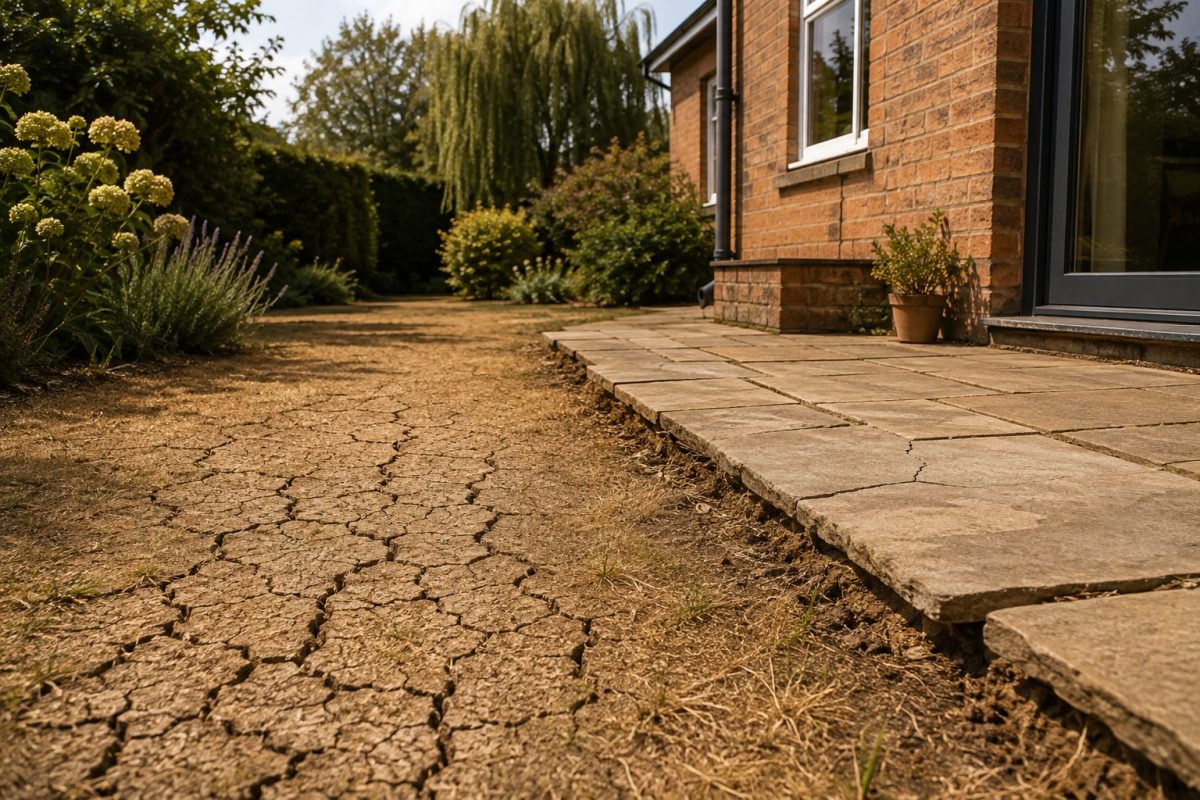
Walk out into the garden this week and you’ll likely find it, a network of fine cracks running across the lawn like a dry riverbed, gaps opening up along the patio edge, maybe a hairline crack that’s appeared somewhere it never used to be.
After weeks of relentless heat, the ground itself is telling us something. The question readers keep asking is: how worried should I actually be?
The honest answer is that most of what you’re seeing is cosmetic and temporary. But a smaller number of cases are genuinely worth watching, and this year, insurers are watching very closely indeed.
Why the ground is doing this
Much of the UK sits on clay-rich soil, and clay behaves almost like a sponge in reverse. It swells when wet and shrinks dramatically when it dries out, sometimes losing a significant volume of water in the process. After a prolonged dry spell like this one, that shrinkage shows up as cracking, in lawns, in borders, in the surface of anything sitting on top of it.
This isn’t a one-off. The insurance industry has now recorded three separate “surge years” for subsidence claims since 2018, namely in 2018, 2022 and again in 2025, and current conditions are being described by claims specialists as tracking a very similar pattern to last year’s record season. Crucially, the ground never fully recovered from 2025’s damage before this year’s dry weather set in, meaning many properties are dealing with cumulative, rather than fresh, stress.
Your garden: mostly fine, with caveats
For lawns and borders, cracking is rarely fatal. Grass typically goes dormant rather than dying outright, and turns green again within a few weeks of proper rain. Cracks in a border are simply the soil shrinking away from itself and will close up as moisture returns.
The bigger risk is to anything growing close to a structure. Thirsty, fast-growing trees and large shrubs, willow, poplar, oak and some fast-growing garden varieties among them, draw huge amounts of water from the surrounding soil as they search for moisture during a drought. If they’re growing within a few metres of your house, that competition for water can pull moisture from underneath the foundations themselves, making tree roots one of the most common contributing factors in subsidence cases near buildings.
Patios and paths
A patio that’s developed gaps or a slight dip is usually just responding to the same shrinkage happening underneath it, the bedding layer has contracted, and the slabs have followed it down. This is generally a maintenance job, not a structural emergency: once the ground rehydrates over autumn and winter, some settlement may partially reverse, and any remaining unevenness can be relevelled.
Where it’s worth paying closer attention is if a patio or path is directly attached to the house and you notice the crack continuing up the wall above it, or the level changing awkwardly where the two meet.
When it’s your house: what to actually look for
This is where this year’s numbers are worth knowing. According to the Association of British Insurers, subsidence claims in the second quarter of 2026 alone cost insurers £72 million, with the average settled claim reaching a record £20,000, up more than £2,000 on the same period last year. Roughly 9,000 households made claims in the first half of the year. Large parts of England are now formally in drought.
None of that means every homeowner with a cracked flowerbed is heading for a five-figure repair bill. Surveyors and insurers generally look for a specific set of warning signs that distinguish ordinary seasonal movement from genuine subsidence:
Diagonal cracks, wider at the top than the bottom, particularly around doors and windows
Cracks wider than about 3mm, roughly the width of a 10p coin
Cracks that appear suddenly, rather than gradually over years
Doors and windows sticking or no longer closing properly
Cracks running through, rather than just along, mortar joints in brickwork
Fine hairline cracks in plaster, or old cracks that have looked the same for years, are almost always nothing to worry about, most houses move very slightly with the seasons regardless.
What to actually do
If you spot genuine warning signs, the advice from the sector is consistent: contact your buildings insurer promptly rather than getting a builder in first, since subsidence is usually covered under standard buildings insurance and the insurer will typically arrange their own structural assessment before any repair work begins. Photographing cracks now, with a coin or ruler for scale, gives you a useful record if movement continues.
For everyone else, the practical advice for this drought is more modest: hold off on major new planting near the house until autumn rain returns and the ground settles, keep a reasonable distance between thirsty trees and shrubs and your foundations when you are planting, and don’t panic-relevel a patio or reseed a lawn that’s simply dormant, most of it will recover on its own once the rain does eventually arrive.
This article is for general information and isn’t a substitute for advice from a structural engineer or your insurer about a specific property.
Comments (0)