
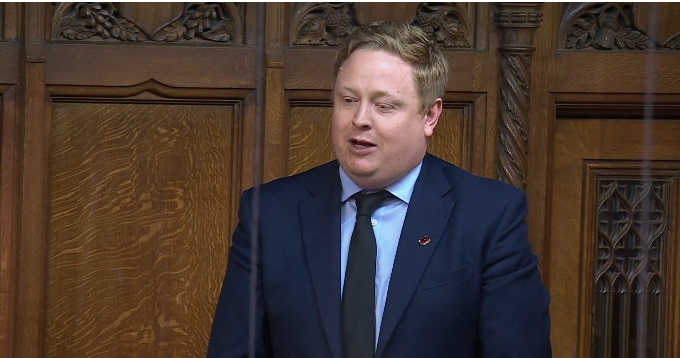
Redditch MP Chris Bloore calls on Government to provide certainty for manufacturers following new regulations
REDDITCH MP Chris Bloore has called on the Government to provide long-term certainty for UK manufacturers as new Extended Producer Responsibility (EPR) packaging regulations are implemented.
Speaking in a House of Commons debate on Packaging Manufacturers Mr Bloore, who serves as Chair of the All-Party Parliamentary Group for Packaging in the Circular Economy, highlighted concerns from local and national supply chain businesses.
While supporting the environmental goals of EPR in principle, the MP warned that proposed annual adjustments to recyclability assessments create business uncertainty and risk hindering investment in local factories.
During the debate, Mr Bloore urged the Government to move away from annual methodological shifts in favour of periodic reviews, combined with a comprehensive post-implementation assessment.
Speaking during the debate, Mr Bloore said: “Businesses need predictability. They need transparency. They need confidence.
“The current plan for annual adjustments to the recyclability assessment and methodology raises concerns. It raises concerns about the long-term certainty that our factories need in order to reinvest.
“Does the Minister agree that it would be helpful if the Government would commit to periodic, rather than annual, methodological changes? And a comprehensive post-implementation review covering manufacturing, employment, investment and material inflation?”
Sarah Champion MP, who secured the debate, agreed with Mr Bloore’s concerns. She criticised real-time regulatory adjustments and pointed out that retrospective policy changes affect business profitability.
Following the debate, the MP said: “Our local packaging and manufacturing supply chains are important for regional economic growth. They are important for sustainable jobs.
“To transition to a circular economy, our businesses need rules that are fair. They need rules that are transparent. They need rules that are stable.
“We cannot expect local employers to make major long-term investments in factory upgrades and sustainable technologies if the rules are changing every year.”
Comments (0)