
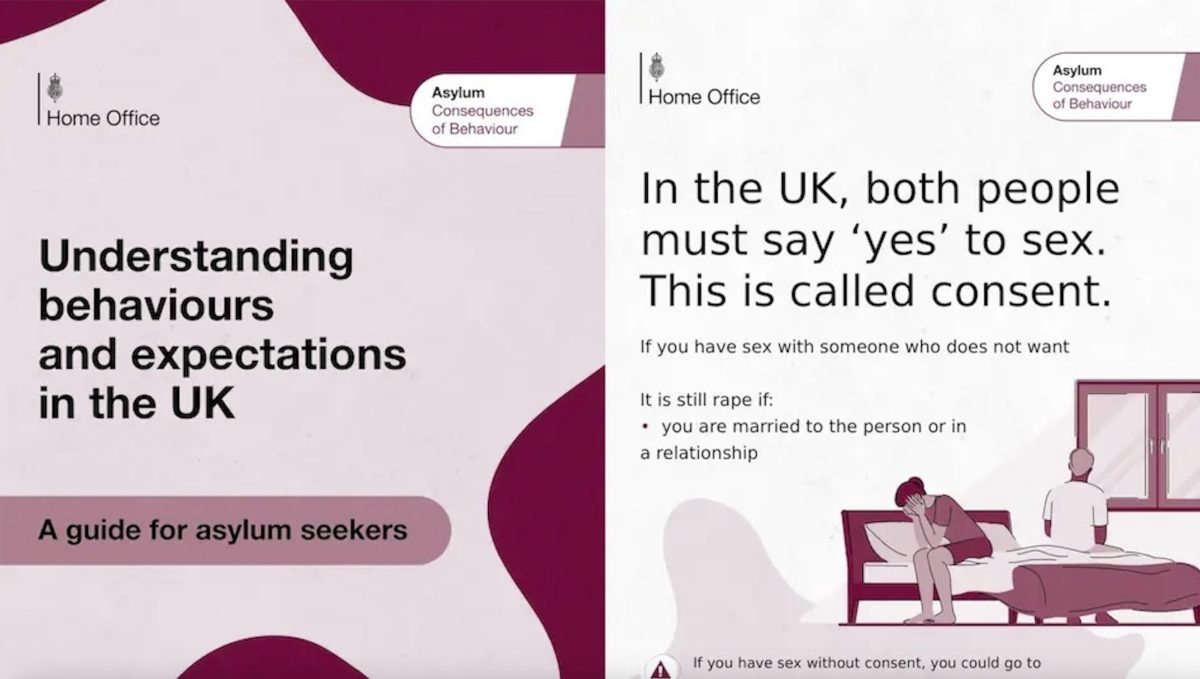
Asylum seekers given Home Office guide explaining rape, consent and women’s rights – NATIONAL NEWS
Official guidance tells new arrivals that women do not need a man’s permission to work or travel, children cannot consent to sex and sexual activity without consent is rape.
ASYLUM seekers in Britain are being given official Government guidance explaining that rape is a serious crime, women have equal rights to men and children under 16 cannot legally consent to sex.
The Home Office has published a guide setting out the laws and standards of behaviour expected from people seeking asylum in the UK, warning new arrivals that British laws and customs may differ from those in their home countries.
The document, Understanding behaviours and expectations in the UK: a guide for asylum seekers, covers sexual consent, gender equality, domestic abuse, the age of consent and acceptable behaviour towards people in public.
It tells asylum seekers that men and women have equal rights in Britain and explains that women are free to work, study and travel without requiring permission from a man.
The Home Office describes equality between men and women as an important part of British culture which is protected by law.
The guidance also contains detailed information about sex and consent, explaining that consent must be given freely by everyone involved in sexual activity and is required regardless of whether two people are married or in a relationship.
New arrivals are told that a person can change their mind after initially agreeing to sex and that somebody who is asleep, intoxicated or otherwise unable to give clear consent cannot consent to sexual activity.
The document explicitly explains that sex without consent constitutes rape and warns that rape is a serious criminal offence.
Those convicted could face imprisonment, while committing offences may also result in the loss of asylum support and accommodation and have consequences for an asylum claim.
The Home Office also explains Britain’s age of consent laws. Asylum seekers are told that the legal age of consent is 16 and that somebody below that age cannot legally agree to sexual activity.
The guidance makes clear that a child’s apparent agreement does not make sexual activity lawful and warns of potentially serious consequences for anybody who breaks the law.
Rules governing behaviour towards women and other members of the public are also set out.
The document warns people against following somebody, blocking their path, making unwanted sexual remarks, whistling or making kissing noises at strangers and making offensive gestures.
It also covers domestic abuse and makes clear that violence or controlling behaviour towards a partner or family member is unacceptable.
The decision to spell out some of Britain’s most fundamental criminal laws and social standards has sparked a political row over immigration and integration.
Reform UK leader Nigel Farage questioned why taxpayers were funding guidance of this nature and asked why people who needed to be given such instructions were being allowed into the country.
Shadow Home Secretary Chris Philp also criticised the guidance, arguing that foreign nationals who commit serious sexual crimes should be removed from Britain rather than the Government attempting to educate people about acceptable behaviour.
The row comes against the backdrop of continuing concern over foreign national offenders in Britain, although foreign national offender figures should not be confused with figures for asylum seekers.
Official Ministry of Justice statistics show that 10,376 foreign nationals were being held in custody in England and Wales at the end of December 2025, representing around 12 per cent of the prison population.
The largest foreign national groups in prison at that point included Albanians, Irish, Polish, Romanian and Indian nationals.
Those figures cover foreign nationals generally and do not show the immigration or asylum status of individual prisoners.
The distinction is significant because there is no comprehensive official dataset demonstrating the overall offending rate of asylum seekers compared with the wider population.
The new guidance is therefore not evidence that asylum seekers as a group are more likely to commit rape or sexual offences.
Instead, the Home Office says the purpose of the publication is to ensure people seeking asylum understand British law and what will be expected of them while living in the country.
The Government document begins by acknowledging that moving to another country can be difficult and that laws and customs in Britain may differ from those elsewhere.
But it makes clear that people living in the UK are expected to follow those laws, warning that breaking them can have serious consequences.
The controversy comes as the Government faces continued pressure over the asylum system, illegal migration and the removal of people without a right to remain in Britain.
Latest Home Office figures show 39,000 returns from the UK were recorded in the year ending March 2026, including enforced and voluntary departures, up seven per cent from 36,500 during the previous 12 months.
Of those, 9,700 were enforced returns, a rise of 13 per cent year-on-year.
At the end of March, 97,519 people were receiving asylum support in Britain, nine per cent fewer than a year earlier and 21 per cent below the peak recorded in September 2023.
The Home Office maintains that everyone coming to Britain is expected to respect the country’s laws and that those who do not can face criminal sanctions as well as immigration consequences.
But the publication of a Government guide explaining principles as fundamental as the equality of women, the protection of children and the requirement for sexual consent is likely to intensify the wider political debate over immigration, integration and the standards Britain should expect from those seeking to make the country their home.
Comments (0)